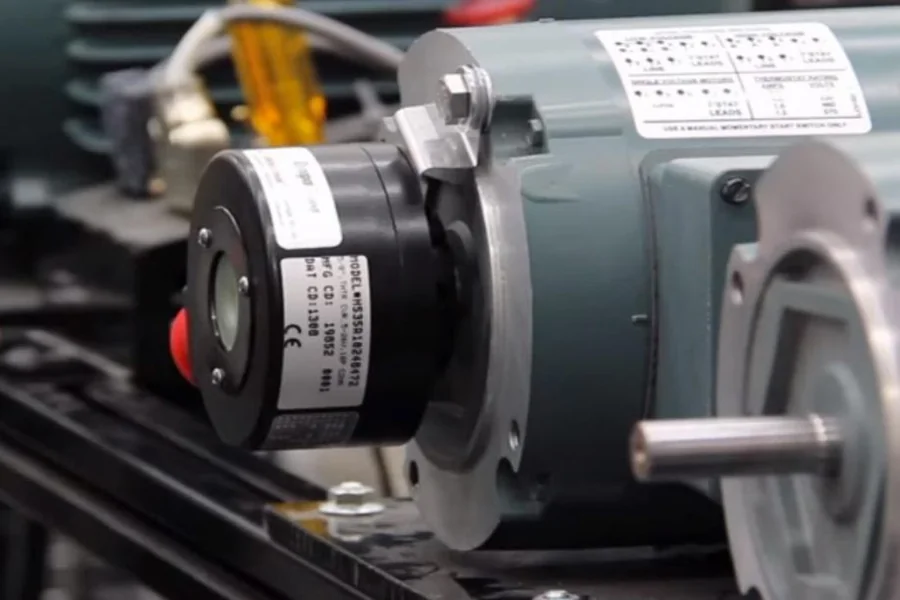

If you’ve ever had to mount an encoder onto a motor or gearbox, you know the shaft type matters. This guide breaks down the real differences between hollow-shaft and solid-shaft encoders — not just the specs.
We’ll look at how each one mounts, when one makes more sense than the other, and what kind of alignment or shock issues to watch out for.
Know when to use hollow shaft vs solid shaft in real-world automation setups like motors, conveyors, and rotary tables.
Get visual and practical guidance — side-by-side comparison tables, use-case breakdowns, pros and cons, plus expert insights on how to choose the right encoder for your application.
What Are Shaft Encoders and Why Do Shaft Types Matter?
Shaft encoders are motion feedback devices that convert rotational movement into electrical signals. They’re essential in automation systems — giving position, speed, or direction data to a PLC, motor drive, or control system. You’ll find them everywhere from CNC machines and conveyor belts to robotic joints and servo motors.
But not all encoders mount the same way — and that’s where shaft type comes in. Whether you’re dealing with a solid shaft, hollow shaft, or blind hollow shaft, the interface directly affects how the encoder is mounted, aligned, and how it handles vibration or torque. Get it wrong, and you might end up with poor readings, premature wear, or even mechanical damage.
In my experience working with both shaft types in real industrial setups, understanding the physical connection method is just as critical as knowing the signal specs. Especially in high-vibration or high-speed environments, the right shaft interface can be the difference between a system that runs for years — or one that fails under load.
What Is a Solid-Shaft Encoder?
A solid‑shaft encoder uses a fixed, non‑hollow shaft that must be connected to the motor or machine shaft through a flexible coupling. This coupling absorbs slight misalignments, protects the encoder bearings, and ensures smooth transmission of rotation. Solid‑shaft models typically mount using a flange or foot/bracket mount, giving you a very stable and rigid mechanical setup.
Because the encoder isn’t mounted directly on the motor shaft, it can tolerate higher shock loads and offers excellent long‑term durability. That’s why I often choose a solid‑shaft design in systems where vibration is unavoidable or where precise alignment is critical — for example, in CNC spindles or heavy‑duty conveyor drives.
In my own work with equipment sourced through Eltra Encoders, I’ve found solid‑shaft encoders to be the safer choice when space allows for a coupling and when mechanical rigidity matters more than compact mounting.
What Is a Hollow-Shaft Encoder?
A hollow‑shaft encoder is designed to slide directly over the shaft of a motor or drive system — either through a fully pass‑through bore or a blind hole configuration. Instead of needing a coupling like solid‑shaft models, these encoders attach via a clamping ring and are stabilized using a torque arm, which prevents the encoder body from rotating with the shaft.
This design makes them incredibly fast and easy to install, especially in tight spaces where every millimeter counts. I’ve used hollow‑shaft encoders during machine retrofits where I couldn’t afford to mess around with bulky couplings or realign entire assemblies. Just slide the encoder on, lock the clamp, fix the arm — and you’re ready to go.
Their compact design, combined with simplified alignment, makes hollow‑shaft encoders a go‑to choice for space‑constrained systems, retrofit automation, and high‑volume production equipment where speed and repeatability are crucial.
Comparison Table: Hollow-Shaft vs Solid-Shaft Encoders
If you’re trying to decide between a hollow-shaft encoder and a solid-shaft encoder, this visual comparison will help. The shaft interface not only affects how the encoder is mounted, but also how it performs under different mechanical conditions — from shock resistance to alignment sensitivity and space limitations.
Each type has trade-offs depending on your application. Here’s how they stack up side-by-side:
| Feature | Hollow-Shaft Encoder | Solid-Shaft Encoder |
| Mounting Method | Direct to shaft, uses torque arm | Coupled via flexible coupling |
| Installation Time | Fast | Longer |
| Alignment Sensitivity | Medium | High |
| Shock Resistance | Lower | Higher |
| Space Requirements | Compact | Needs room for coupling |
| Ideal For | Retrofitting, tight spaces | Rugged setups, precise alignment |
| Cost | Slightly higher (torque arm needed) | Usually lower |
In my experience, hollow-shaft encoders are a lifesaver when space is tight or when you need to keep installation time short — especially during retrofits. But if you’re working with high-vibration machinery or need tight mechanical alignment, solid-shaft encoders (like those available from brands on Eltra Trade) offer more rigidity and robustness.
When to Use a Hollow-Shaft Encoder (Pros & Cons)
Hollow-shaft encoders are my go-to in space-constrained applications or when I need to minimize installation time. They slide directly onto a motor shaft and are secured with a clamping ring and a torque arm — no coupling required. This makes them especially valuable during retrofits or when working with compact servo motors.
Advantages
- Easier and faster to install, especially in tight spaces
- Eliminates the need for shaft couplings
- Great fit for retrofits, packaging lines, and rear-shaft servo motor setups
Considerations
- Slightly lower resistance to shock and vibration
- Requires a torque arm, which adds a bit of complexity during mounting
When to Use a Solid-Shaft Encoder (Pros & Cons)
Advantages
Solid‑shaft encoders shine when the environment gets rough. Because they’re mounted through a coupling rather than directly onto the motor shaft, they handle vibration and mechanical stress exceptionally well. You also get a wider selection of industrial mounting options — including servo flanges, synchro flanges, and foot mounts — which makes them a dependable choice for heavy‑duty or high‑precision setups.
- Rigid and reliable, especially in high‑vibration or impact‑prone environments
- Better mechanical isolation thanks to the coupling between the encoder and drive shaft
- More mounting flexibility, ideal for industrial machinery and precision applications
Considerations
This robustness comes with a trade‑off. Solid‑shaft encoders require a coupling, and that means extra components, more precise alignment work, and a bit more installation time. If you’re tight on space or doing a quick retrofit, these can slow you down.
- Needs a flexible coupling, adding cost and installation steps
- More sensitive to alignment, so setup takes longer and demands careful positioning
How to Choose Between Hollow-Shaft and Solid-Shaft Encoders
Choosing the right shaft encoder starts with understanding the mechanical layout of your system and what trade-offs you’re willing to accept in terms of installation ease, space, and durability. I’ve worked with both types — and in many cases, the right choice boils down to physical constraints, environmental conditions, and maintenance preferences.
Here’s a practical step-by-step guide to help you decide:
- Check available space around the motor shaft, and whether you have rear shaft access. Hollow-shaft encoders save space and are easier to mount in tight setups.
- Define the shock and vibration levels of your application. If you’re in a high-vibration environment, solid-shaft encoders with coupling tend to hold up better.
- Assess install time, cost, and serviceability. Hollow-shaft options install faster, but they may require a torque arm and might be slightly more expensive.
- Match the encoder shaft style to your motor or drive shaft design. Some motors come ready for blind-hollow mounting, while others require couplings.
- Consider your application type — OEM machine builds, field retrofits, heavy-duty conveyors, or precision motion systems all have different needs.
- Confirm mounting accessories, such as whether you’ll need a torque arm (for hollow-shaft) or a flexible coupling (for solid-shaft).
Whether you’re working on a robotic arm, a servo axis, or retrofitting an old conveyor line, these considerations will help you avoid costly misfits and speed up your install.