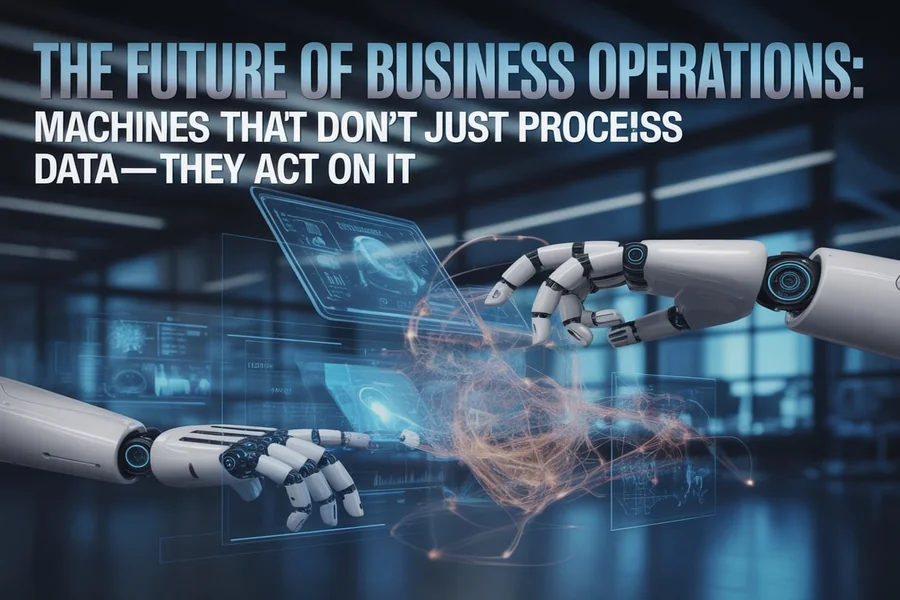

Businesses are undergoing a profound shift in how they approach operational efficiency and intelligence. For decades, automation was built around predictable rule execution—software followed scripts, triggered alerts, and processed information only after being explicitly instructed to do so. But today, companies are transitioning into a new era where systems don’t simply respond to commands; they anticipate needs, interpret situations, and perform actions autonomously. These are no longer passive data-processing tools, but active digital participants in business operations.
The difference between traditional automation and emerging autonomous systems is night and day. Conventional automation can move data, file forms, send notifications, and replicate predefined human actions. But these new systems can observe patterns, infer business logic, identify exceptions, and determine when to escalate issues or intervene without waiting for a manual trigger. They function more like assistants than calculators—an evolution that is accelerating across multiple sectors.
This transformation is driven in large part by the rise of agentic AI, a form of intelligent system architecture that allows software to reason, decide, and act. Instead of merely offering suggestions or summaries, these systems initiate actions in workflows, simulate reasoning processes, and apply learned knowledge to real business environments. The result is a digital workforce capable of complementing human teams, rather than just serving them.
From Reactive to Proactive Operations
In the past, a business system would be used to respond to inputs:
- A customer emailed → the agent replied.
- A transaction occurred → the system logged it.
- A rule was triggered → an alert was sent.
But today’s autonomous business systems recognize patterns before humans do and act without waiting for signals. In retail, for example, these systems don’t just track inventory—they predict stock depletion, reorder supplies, and dynamically adjust pricing based on demand signals.
Companies moving into proactive operations gain:
- faster response times
- lower operational latency
- improved accuracy
- Reduced human workload
- more consistent decision-making
By eliminating the delay between data interpretation and execution, autonomous software enhances the speed of business.
Industry Example: Financial Services
Financial services require precision, insight, and risk sensitivity. Modern adaptive software now performs:
- autonomous transaction monitoring
- fraud detection and intervention
- credit behavior analysis
- multi-step compliance checks
What makes these systems transformative is not just that they analyze information, but that they can independently trigger holds, request authentication, or block suspicious behavior. Banks report faster fraud containment and reduced operational overhead because these systems execute safeguards faster than human analysts.
Industry Example: Human Resources and Talent Management
Historically, HR systems simply stored employee information or filtered resumes. Today’s systems take action:
- automatically identifying attrition risk
- recommending candidate matches
- optimizing internal mobility
- scheduling interviews
- generating performance trend analytics
These tools learn from organizational culture and hiring history. If a company repeatedly selects a certain skill set for success in a role, the system recognizes the pattern and adapts accordingly.
Industry Example: Logistics and Supply Chain
Supply chain execution once hinged on predefined logistical rules. Autonomous systems now:
- Detect route inefficiencies
- predict disruptions
- redirect shipments
- reprioritize deliveries
- coordinate warehouse movement in real time
As a result, supply chains become resilient rather than reactive. Instead of waiting for something to go wrong, the system prevents inefficiencies before they occur.
Machines That Understand Business Priorities
This shift is about more than just data utilization. These systems are beginning to internalize business objectives. For example, in a marketing department, software might:
- Detect underperforming campaigns
- adjust messaging or targeting
- reallocate spend
- measure impact
- iteratively optimize
In IT operations, platforms might:
- Detect system vulnerabilities
- deploy patches
- update configurations
- notify relevant teams
- document changes
In procurement, systems compare supplier performance, unit cost variations, and historical reliability—not just as passive reports, but as actionable insights.
The Evolution of Corporate Decision-Making
This new class of business technology also forces companies to reconsider their internal decision structures. Instead of humans being the only executors of strategic logic, machines now share operational authority.
The second usage of agentic AI in this context illustrates how these systems proactively initiate steps toward desired outcomes. They don’t merely describe what might happen—they move the business toward the optimal state.
Human + Machine Synergy
Some worry that these capabilities might reduce the need for human labor. In reality, it shifts human roles upward rather than eliminates them.
Humans remain best at:
- creative reasoning
- emotional empathy
- strategic long-term planning
- ethical judgment
- relationship building
Machines excel at:
- large-volume data processing
- pattern identification
- real-time optimization
- instantaneous action
- procedural consistency
This division of strengths results in a partnership rather than a replacement. Humans focus on direction; machines handle execution.
Implementing Autonomous Systems Successfully
For companies adopting these operational systems, success depends on several factors:
- Process Visibility
Organizations must clearly understand their workflows, decision chains, and exceptions. - Data Infrastructure
Systems can only learn from clean, accessible data streams. - Cultural Readiness
Employees must trust the technology rather than fear it. - Gradual Delegation Models
Companies benefit from phased implementation:
First: let the system assist.
Then: let it be recommended.
Finally: let it act.
This progressive handoff retains control and confidence.
Looking Forward
The companies that will dominate in the next decade are the ones that build hybrid work environments where people set intent and machines carry it out. The future will not be defined by businesses with the most data, but by those with the most actionable data—data that moves and executes rather than just sits in dashboards.
Machines that act instead of merely observe will reshape how companies operate. Businesses that embrace this operational shift will experience acceleration in execution speed, reduction in human error, and a step-change in scalability. Organizations that cling to reactive processing will increasingly find themselves outpaced by competitors who have delegated execution to autonomous systems.