
Cancer is so deadly that the word is now used outside of the medical context to describe something destructive. For better context, reports show it as one of leading causes of death. According to a study carried out by Lisa M. Force, M.D., M.P.H., from the University of Washington in Seattle, by 2050, it is projected that cancer will cause about 18.6 million deaths.
Using the 2023 framework for Global Burden of Diseases, Injuries, and Risk Factors Study, the researchers determined that cancer, which was the second highest cause of death in 2023, remains a major factor in global diseases burden. Sadly, the researchers hold the bleak view that the impact of cancer on the global disease burden will continue to increase in the coming decades. For more on this, you can see: https://www.renalandurologynews.com/.
Drug researches that aim to find a lasting solution to cancer are, therefore, a welcome development. Therefore, this piece discusses the experimental drug Pidnarulex (CX-5461) and how it may help this course.
Understanding How Cancer Operates
Diagnosis is important in the clinical field as it reveals what the problem is. It is not about solving the problem but revealing it. However, it is important because awareness of a problem serves as the first step toward solving it.
On that note, we cannot overemphasize the fact that cancer is a problem, and a big one at that. Understanding how cancer operates is, therefore, a huge step towards winning the battle against it.
Cancer are cells but a kind that does damage to the body. This happens because they typically violate normal cell processes.
A normal cell grows, proliferates, and even dies in an orderly manner. However, this is not the case with cancerous cells. They disobey the signals that should determine cell growth, proliferation, and death. DNA mutations (mistakes) mainly cause this, and any or many of several factors could cause these mutations:
- Inherited Genes – Could be inherited
- Environmental Factors – Through exposure to things like certain chemicals, radiation, or smoke
- Random Errors – This could happen with cells
Their unprecedented growth (especially) causes the formation of a tumor, which is the term for a tissue lump. This is mostly the case, except for cancer types like leukemia (blood cancer) that lack solid tumors. The implications include the following:
- Violating signals that determine normal cell growth
- Extended cell life even after damage – Normal cells self-destruct when damaged, but these don’t
- Metabolic changes – Leading to increased energy consumption and quicker growth
- Stress adaptation
The worst part is that they then invade nearby tissues and (possibly) organs. Their damage can even be far-reaching, as they move far from their immediate environment to cause damage. A process known as metastasis causes this.
How Pidnarulex (CX-5461) Is Supposed to Solve the Problem of Cancer
Pace is one of the key differences between normal and cancerous cells. The latter grows way faster than the former. This is one of the major reasons why early detection and intervention are in the best interest of affected people.
The quick pace of cancerous cell growth requires certain things, and there are several ways that Pidnarulex (CX-5461) RNA Polymerase I Inhibitor is aimed at disrupting the process. Some of the ways include the following:
Targeting the Cancer Factory
Almost every living cell produces something known as ribosomes, and cancerous cells are no exception. Ribosomes are integral to the development of a cell’s structure and even how it functions.
This is because they require protein for their structural development and functioning, and ribosomes perform protein synthesis. As a result, the lack of ribosomes means that cells would have a huge problem developing their structure and functioning as they should because of their lack of the required protein.
Pidnarulex (CX-5461) disrupts an enzyme known as Pol I. This enzyme is what makes rRNA, which in turn results in the development of ribosomes. In simpler terms, disruption of the Pol I enzyme means that:
- Making ribosomes becomes impossible
- Cancerous cells’ structural development and functions are threatened
- Cancerous cells’ growth, division, and proliferation become impossible
This is the major way researchers intend to use Pidnarulex (CX-5461) to prevent the progression of this disease.
Stress to Cancer Cells
Just as normal cells should identify and respond to specific signals, cells can send their own signals when the need arises. When they receive no supply of the much-needed ribosome, the cancer cells send their own signal. This is a distress signal that ultimately forces the cancerous cell to do the following:
- Stop Cell Division and Proliferation
- Attempt Self-Repair
- Apoptosis (Self-Destruction)
The goal is to have these cells die. However, this might not happen instantly, but preventing its spread would do so, at the very least.
Exploitation of the Cancerous Cell’s Weaknesses
Every cell has DNA. DNA mutation of cells causes cancer in the first place.
In many cases, this mutation means these cells have a faulty DNA repair system in place. BRCA1 or BRCA2 mutations are typical examples.
The use of Pidnarulex (CX-5461), therefore, means these cells may be unable to cope with the additional damage this experimental drug causes. As a result, the drug may collapse and kill them.
Normal cells, on the other hand, should be able to handle the impact of the blow. This is because their repair system is still intact. The technical term for this approach, which is called synthetic lethality, is one of the brightest ideas in the fight against cancer.
Enhancing the Immune System
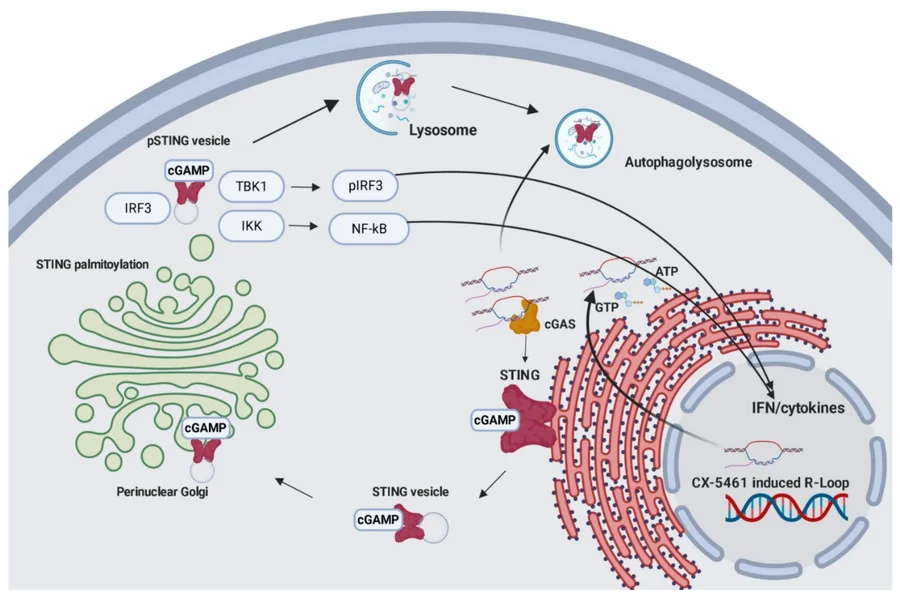
Ongoing research suggests the ability to enhance the body’s immune system is one of the surprising effects of using Pidnarulex (CX-5461). Pidnarulex (CX-5461) triggers cGAS-STING through its activities in the cell.
cGAS-STING essentially warns the immune system of a foreign invader (DNA leaks in the cell’s outer area). The immune system then attacks, and it works even more effectively when combined with immunotherapy drugs.
So, the body’s very own immune system strikes the final blow. Although still at the experimental phase, ongoing studies using Pidnarulex (CX-5461) for cancer treatment are revealing quite a lot. It is helping in the following ways:
- Helping researchers understand how cancerous cells respond to stress
- Discovery of loopholes that can be exploited in tumors
- Development of long-lasting and smarter cancer treatment plans
In simpler terms, the goal of using Pidnarulex (CX-5461) is to hit cancer at the very source – cell growth.
Final Note
Research involving the use of Pidnarulex (CX-5461) for cancer treatment has been showing some promising signs. While there are still concerns and even limitations, the progress being made is encouraging and gives hope to many people dealing with various types of cancer.